
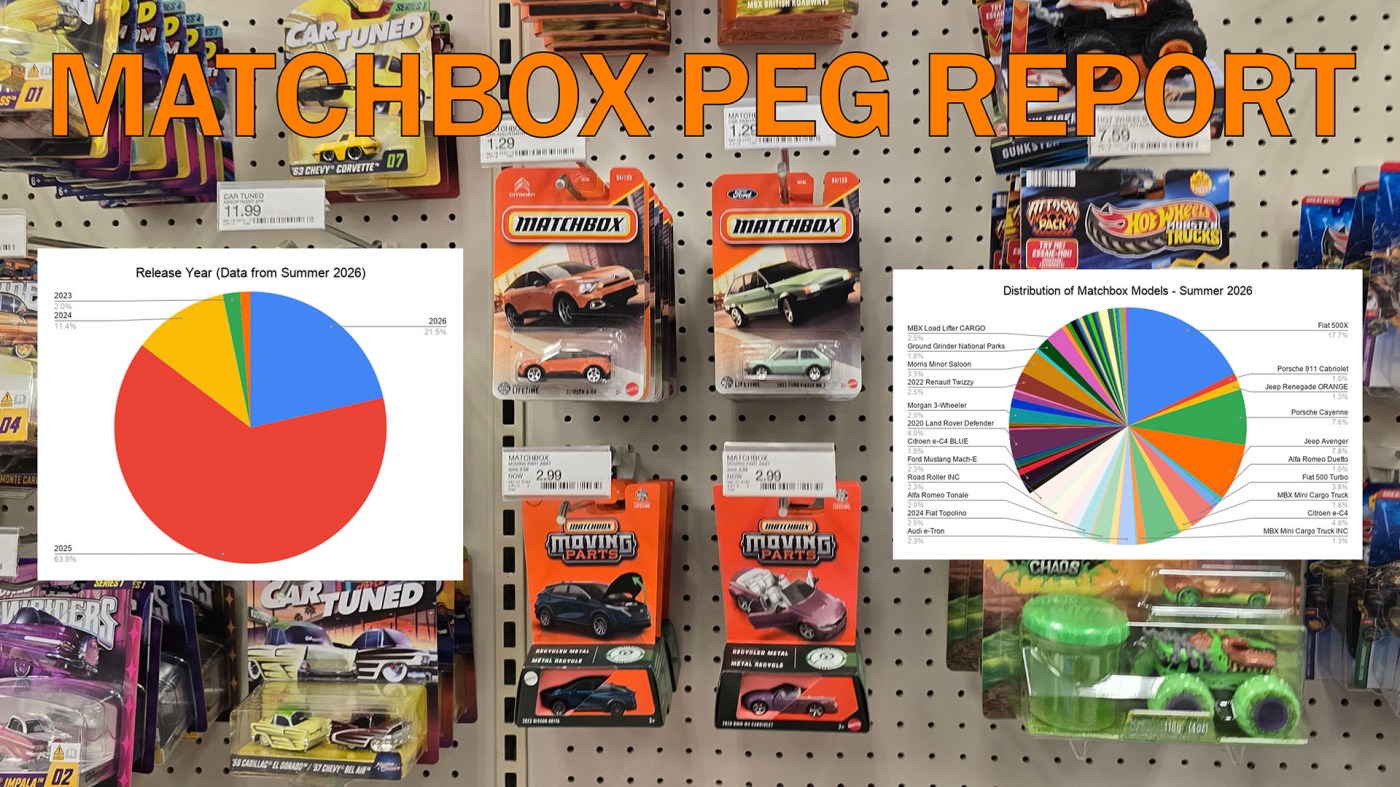
Last summer, I grew so frustrated with Matchbox’s slow inventory turnover and distribution issues that I decided to conduct a census of 10 of my local stores to get a better sense of the scale of the problem (and, hopefully, to help give the Matchbox team some much needed data so they could work on solving the problem). Well, if you’ve been to pretty much any major retailer this summer to hunt for Matchbox cars, you know the pegwarmer problem is far from solved. That meant it was time for another census – and this year I upped the ante!
Last year, my census was limited to 5 Walmarts and 5 Targets around my metro area. This year, I expanded my search to 8 Walmarts and 18 Targets across multiple metro areas. This census was conducted between late July and early August, 2026. I decided to focus on Target specifically this year because they have reduced the peg space allocated to Matchbox considerably in their most recent toy section redesign, making statistics like inventory turnover even more important than they otherwise would be to the future success of the Matchbox brand.
Let’s start with some baseline comparisons to last year, in order to get a better sense of where the line is today and how it has changed over the last year. The average number of Matchbox mainlines per store has decreased significantly from 26 cars in 2025 to just 15 in 2026. This is mostly due to the reduced peg space at Target stores: the average Target had just 13 cars this year, compared to 20 at the average Walmart.
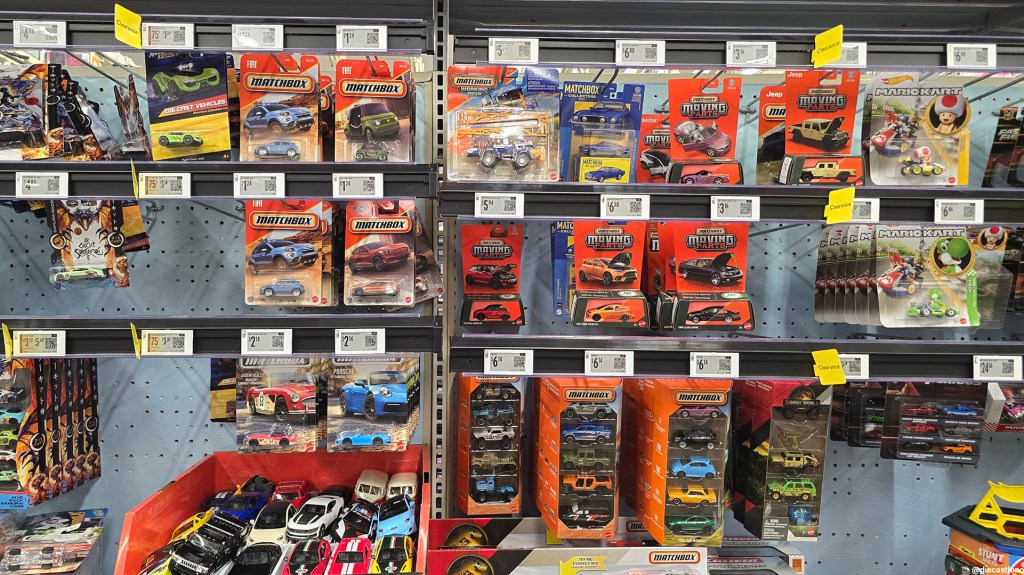
The mix of cars on the pegs has also changed this year. I identified 3 common pegwarmer attributes last year: EVs, crossovers, and generic castings. The share of electric cars warming the pegs has actually gone down quite a bit this year, from 42% of the inventory last year to just 30% this year. Unfortunately, that improvement is counteracted by a significant growth in the number of crossovers on the pegs, up to 54% of the models this year from just 35% last year. The proportion of generic castings has stayed roughly the same, up to 16% this year from 14% last year.
Those statistics aren’t great on their own, but they’re also an indicator of the bigger problem the Matchbox line faces: inventory turnover. Inventory turnover describes the amount of time it takes for a store to cycle through their products, with Target’s current average days to sell sitting around 60. For the Matchbox line to be healthy, it needs to meet (or ideally beat) that average.
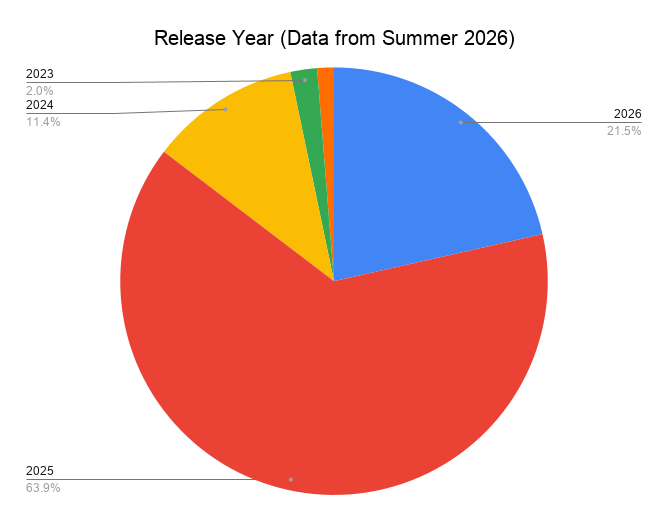
For the sake of simplicity, I decided to classify any model released in 2026 as “current” inventory and anything released in 2025 or before as “non-current” inventory. In my census from last year, about 38% of the models on the pegs were non-current. In this year’s survey, that number shot up to an eye-watering 77%. That’s…not good, to say the least. It’s important to remember that all Matchbox mainlines share the same UPC, so as far as Target is concerned fast-moving models like the McLaren F1 GT and Mazda RX-7 will help counteract the slow-moving crossovers that warm the pegs. That makes it impossible to get a true sense of the Matchbox line’s inventory turnover metrics by just observing the pegs, but 77% of the models on the pegs being over six months old certainly isn’t a positive indicator. Plus, those desirable, statistic-improving models can only be bought if they actually make it to the pegs in the first place, which requires space.
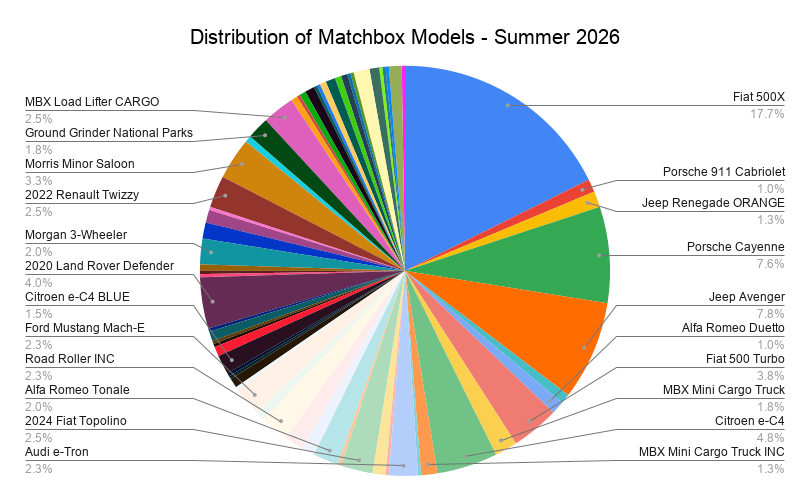
If we take a closer look at the model breakdown, a few models immediately jump out. The Fiat 500X is by far the most common model on the pegs, representing nearly 18% off all Matchbox inventory. It’s followed by the Jeep Avenger and Porsche Cayenne, which each make up about 7.5% of the models on the pegs. The 500X, Avenger, and Cayenne all have something in common – they’re overrepresented at Target stores, which seem to have gotten stuck with seemingly endless late-2025 mainline cases. Those 3 were much less prevalent at Walmarts, though they could definitely still be found there. With the exception of those 3 models, the pegs actually featured a more diverse set of models than last year (though far too many of them were non-current models).
The mainline is clearly in rough shape right now, but the Moving Parts line isn’t much better. It’s certainly looking better than the mainline in terms of product age, with only 18% of the Moving Parts models on the pegs being from 2025 or before. Some of that might be down to the line’s smaller case sizes, but most of it is probably just lack of inventory to begin with. The average store had just 6 Moving Parts models on the pegs this summer, which doesn’t give customers a lot of selection to choose from. Even worse, the pegs at most stores are dominated by just a few problematic castings. If you’ve seen my post about the pegwarming purple BMW M4 Cabriolet, you won’t be surprised to see it topping this list, accounting for roughly ⅓ of all the Moving Parts models in the census. Likewise, the Nissan Ariya that dominated last year’s census is still hanging around, though its numbers have decreased over time.
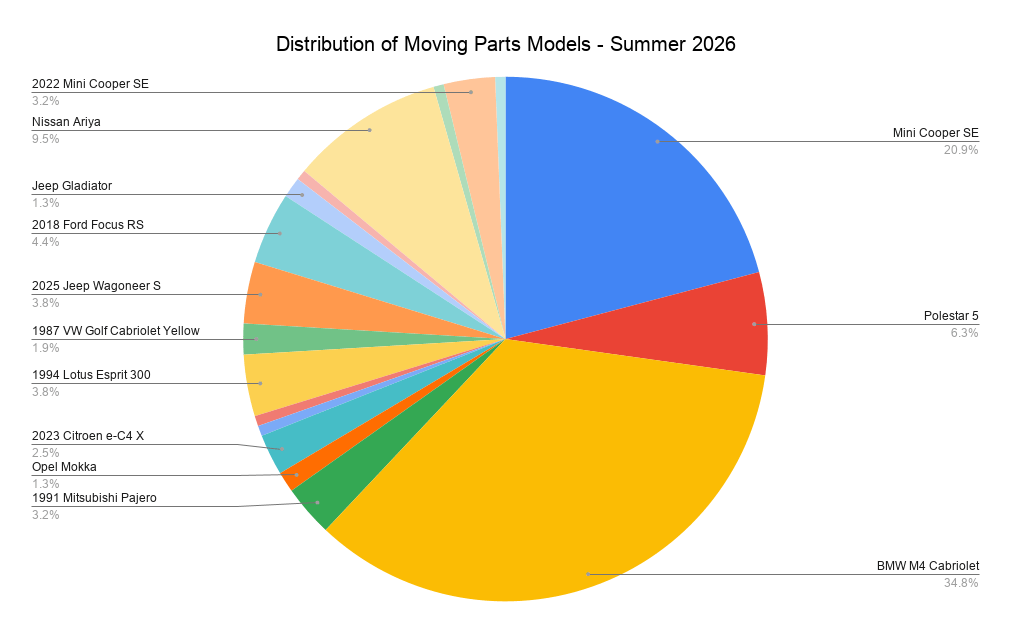
A detailed model breakdown of the Moving Parts line looks even worse than the mainline, with over half the pie chart taken up by just the BMW M4 and Mini Cooper SE. What’s particularly significant is what’s not on this breakdown – there’s a distinct lack of desirable performance cars on the pegs, despite Matchbox producing several of them this year!
There’s a few lessons to be learned here. First, I think it’s well past time for Matchbox to increase the case quantity for the Moving Parts line. 10 models per case would be good, but I think 12 is the sweet spot. This would allow for more variety, which would ideally lead to more individual collectors buying more models (increasing inventory turnover) while adding more diversity to the models left on the pegs. Second, Matchbox should avoid doubling up on a single casting in a given case, especially if it isn’t a new casting. This sounds obvious, but Matchbox seems to keep making the same mistake. The infamous pegwarming purple BMW M4 was packed two per case, which would only have worked out if it was twice as desirable as every other model in its case. There might be a benefit to doubling up on hyped models like this year’s Acura Integra Type S, but those models would have to be chosen very carefully.
To be clear, I didn’t write this whole article to hate on Matchbox. I absolutely love this brand and I want it to be successful over the long term, which will require the team to get their act together going forward. The folks in El Segundo have requested that collectors share pictures of the pegs in their local stores using #mymatchboxpegs to help them better understand the state of their distribution problem. I hope this census can serve as an even better, more in-depth version of that exercise so we can get more desirable Matchbox mixes going forward. I’d love to hear how your diecast hunting experiences compare to mine, and I’m sure the Matchbox team would as well, so I encourage you all to go out and conduct similar data-gathering exercises. The more data we have, the better our understanding of the problem! Don’t forget to get subscribed, because it seems like the Matchbox Peg Report is going to become an ongoing series!
Like what I do? Subscribe so you don’t miss any posts!
 diecastleno.com
What I’ve experienced in suburban Portland OR retailers (WalMart, Target, Fred Meyer/Krogers) mirrors your report.
Each retailer has its bright and sore spots. Target has the most recent Moving Parts models (2026 assortment 7, though it skipped assortment 6). Meanwhile, WalMart and Fred Meyer are still stocking the purple BMW convertible. However, Fred Meyer and Walmart are now stocking the most recent basic models (carded in both stores; power grabs at Fred Meyer).
Dollar Tree and Five and Below are also stocking recent basic models. Would Matchbox/Mattel consider contracting with Dollar Tree and Five and Below to sell their Moving Parts line??
LikeLike
I suspect the Moving Parts line might be too expensive for Dollar Tree but it seems like a good fit for Five Below. Also, bring back proper toy stores like Toys R Us!!
LikeLike
My own experience with small parts showed a similar slowdown in getting items to shelves. This pattern suggests a deeper structural issue beyond just local inventory.
LikeLike
Username checks out! Interesting to hear that the issues permeate beyond diecast…
LikeLike